

The 19 July Revolution: How Rojava Reshaped Northern and Eastern Syria
Kurdistan 06:30 PM - 2026-07-19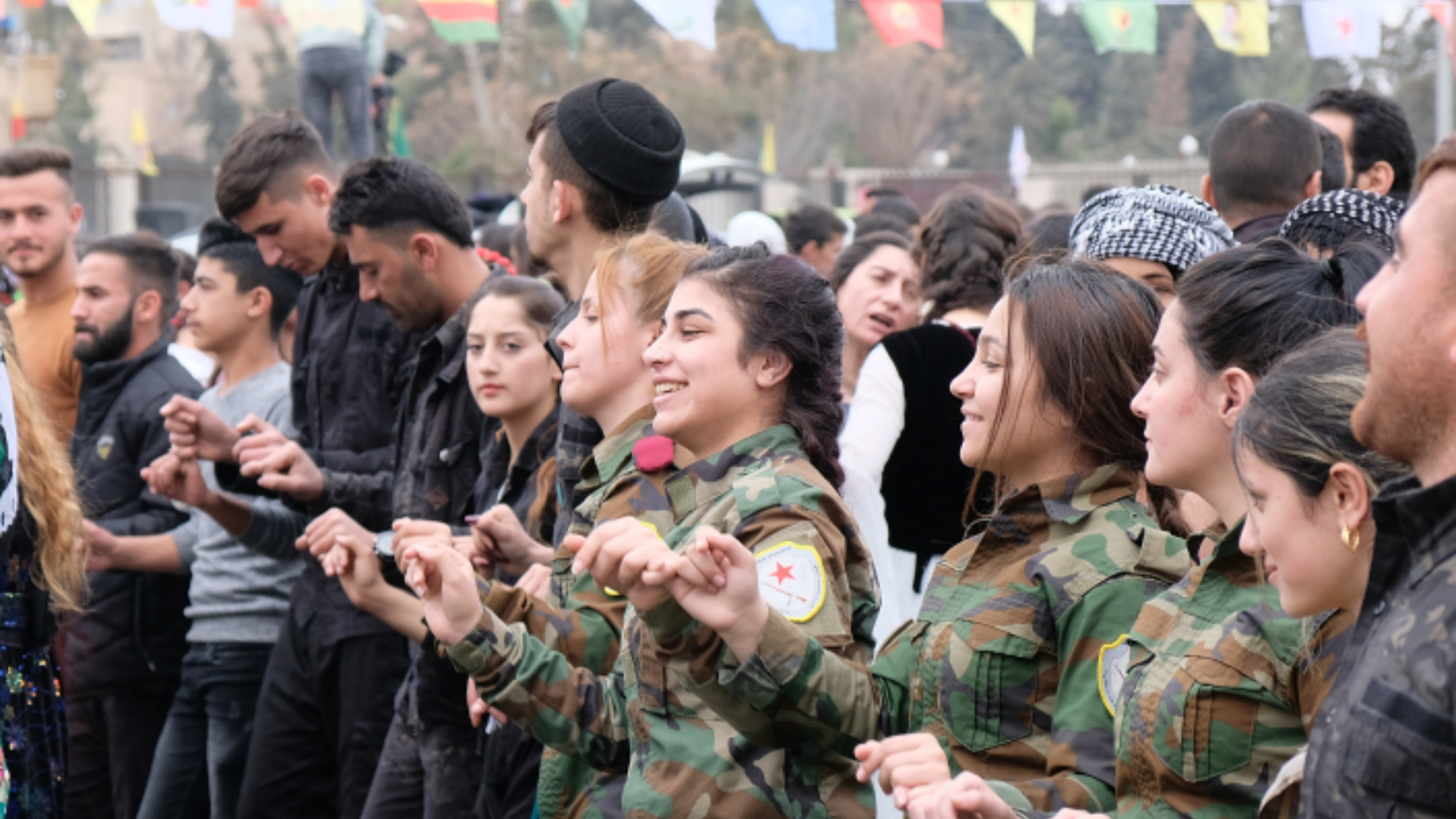 Rojava Information Centre
International Women’s Day in Qamishlo, 8 March 2022.
The 19 July 2012 Revolution, widely known as the Rojava Revolution, is regarded as one of the defining political and military developments in Syria over the past decade. It marked the emergence of a new system of governance across large parts of northern and eastern Syria, eventually leading to the establishment of the Autonomous Administration of North and East Syria (AANES).
Rather than being a spontaneous event, the revolution was the culmination of decades of Kurdish political and social activism in Syria, combined with the profound upheaval triggered by the Syrian uprising that began in March 2011. As state authority weakened across large parts of the country, local actors sought alternative ways to administer their communities and maintain security.
The 'Third Way'
As the Syrian conflict intensified, Kurdish political forces in northern Syria found themselves caught between the Syrian government and the armed opposition. Distrustful of both sides, they adopted what became known as the "Third Way"—a strategy of avoiding alignment with either camp while developing autonomous political, civil and security institutions.
The approach sought to establish local self-governance, protect communities from the wider conflict and promote decentralised administration based on popular participation. Its supporters argued that governance should include the region's diverse ethnic and religious communities rather than be dominated by any single political or military force.
The Beginning in Kobani
The revolution began on 19 July 2012 in Kobani (Ayn al-Arab) after Syrian government forces withdrew from several Kurdish-majority areas to reinforce positions in larger cities.
Local councils and popular committees assumed responsibility for public institutions, while government offices and Ba'ath Party headquarters came under local control. Similar developments soon followed in Afrin, Amuda, Derik, Derbasiya and Qamishli, where new administrative bodies and neighbourhood communes were established to manage local affairs.
Establishing Self-Administration
As the system expanded, local governance evolved into more structured political institutions. In 2014, the Democratic Self-Administration was formally declared across parts of northern and eastern Syria.
The administration established councils and specialised bodies responsible for education, healthcare, public services, economic affairs and internal security. One of its defining features was the adoption of a co-chair system, under which many institutions were jointly led by one man and one woman in an effort to promote gender equality in public life.
The Role of Women
The Rojava Revolution became internationally recognised for the prominent role played by women in both civilian and military institutions.
The Women's Protection Units (YPJ) emerged as an all-female military force that fought alongside the People's Protection Units (YPG) in battles against the Islamic State (ISIS). Their participation attracted global attention and came to symbolise the administration's emphasis on women's political and social participation.
Women also assumed senior positions across the Autonomous Administration's civil institutions, making gender equality a central component of its governing model.
From Kurdish Movement to Multi-Ethnic Administration
Although the revolution began in predominantly Kurdish areas, the project gradually expanded to incorporate the region's wider ethnic and religious communities.
Arabs, Syriacs, Assyrians, Armenians and Turkmen became represented in political institutions, local councils and security structures. Supporters increasingly presented the administration as a model of shared governance for the diverse peoples of northern and eastern Syria.
Military Turning Points
The Battle of Kobani
The Battle of Kobani (2014–2015) marked one of the most significant turning points in the war against ISIS.
After months of intense fighting and with support from the US-led international coalition, Kurdish forces successfully defended the city and ultimately drove ISIS from the area. The battle became a symbolic victory that helped reverse the group's momentum across Syria and Iraq.
Formation of the Syrian Democratic Forces
In 2015, the Syrian Democratic Forces (SDF) were established as a coalition of Kurdish, Arab, Syriac and other armed groups.
Backed by the international coalition, the SDF became the principal force fighting ISIS in northern and eastern Syria, later capturing key territories including Raqqa in 2017, the group's de facto capital in Syria.
Turkish Military Operations
The Autonomous Administration has also faced repeated military operations by Turkey, most notably:
Operation Olive Branch in Afrin (2018).
Operation Peace Spring targeting Ras al-Ayn (Serekaniye) and Tell Abyad (Girê Spî) in 2019.
Those operations resulted in major security and demographic changes in the affected areas and continue to pose significant political and humanitarian challenges for the administration.
A New Political Phase
Following major political changes in Syria and the country's ongoing transition, relations between the Autonomous Administration and the new authorities in Damascus have entered a new phase.
After months of negotiations, a new process of dialogue culminated in an agreement between Syria's interim President Ahmed al-Sharaa and Mazloum Abdi, Commander-in-Chief of the Syrian Democratic Forces.
The discussions have focused on redefining the relationship between the Autonomous Administration and the Syrian state, including proposals for integrating SDF forces into national military institutions while preserving regional stability.
The Syrian authorities have also introduced legal measures addressing aspects of Kurdish citizenship rights, which many observers regard as part of broader efforts to reshape relations between the central government and Syria's diverse communities.
Legacy
The July 19 Revolution remains a landmark event in the modern history of northern and eastern Syria. What began as a Kurdish-led movement evolved into a broader political and administrative project encompassing multiple ethnic and religious communities.
Regardless of differing political assessments, the revolution has profoundly influenced the Syrian conflict by placing issues such as decentralisation, local governance, minority rights, women's participation and community-based administration at the centre of national debate.
Today, the Autonomous Administration faces a new challenge: moving beyond years of armed conflict towards a political settlement capable of safeguarding its institutions while defining a sustainable relationship with the Syrian state.
PUKMEDIA
More news
-
Yemen's Houthis Declare Naval Blockade Against Saudi Arabia
05:43 PM - 2026-07-20 -
Hundreds Protest in Delhi Demanding Statehood for Indian Kashmir
02:40 PM - 2026-07-20 -
Andy Burnham Becomes UK Prime Minister, Pledging to ‘Rewire Britain’
10:46 AM - 2026-07-20 -
Oil Surges Above $90 as Gold Declines Amid Rising Regional Tensions
10:17 AM - 2026-07-20
see more
.jpg)
.jpg)
Kurdistan Region Asayish Arrests Two Suspected ISIS Terrorists
10:57 AM - 2026-07-20
.jpg)
PUKMEDIA Releases Weekly Digital Newsletter- Issue 183
09:22 AM - 2026-07-20
Latif Nerwayi: President Bafel's Message Emphasised Unity to Overcome Challenges
07:58 PM - 2026-07-19
The 19 July Revolution: How Rojava Reshaped Northern and Eastern Syria
06:30 PM - 2026-07-19
Most read
-
CENTCOM Releases Update on U.S. Troops Killed and Missing in Gulf Attacks
Kurdistan 10:51 PM - 2026-07-19 -
French Mediterranean Wildfire Spreads Rapidly, Prompting Evacuations
World 09:25 PM - 2026-07-19 -
PUKMEDIA Releases Weekly Digital Newsletter- Issue 183
Kurdistan 09:22 AM - 2026-07-20 -
Kurdistan Region Asayish Arrests Two Suspected ISIS Terrorists
Kurdistan 10:57 AM - 2026-07-20 -
The 19 July Revolution: How Rojava Reshaped Northern and Eastern Syria
Kurdistan 06:30 PM - 2026-07-19 -
Parliament Orders Dismissal of Naval Commanders After Kuwaiti Coast Guard Attack on Iraqi Fishermen
Iraq 04:31 PM - 2026-07-19 -
Latif Nerwayi: President Bafel's Message Emphasised Unity to Overcome Challenges
P.U.K 07:58 PM - 2026-07-19 -
Andy Burnham Becomes UK Prime Minister, Pledging to ‘Rewire Britain’
World 10:46 AM - 2026-07-20
The News in your pocket
Download
 Application